A Momentary Variation of Voltage From One Logic Level to the Opposite Level and Back Again
Transistor–transistor logic (TTL) is a logic family built from bipolar junction transistors. Its name signifies that transistors perform both the logic function (the first "transistor") and the amplifying function (the second "transistor"), every bit opposed to resistor–transistor logic (RTL) or diode–transistor logic (DTL).
TTL integrated circuits (ICs) were widely used in applications such every bit computers, industrial controls, examination equipment and instrumentation, consumer electronics, and synthesizers. Sometimes TTL-compatible logic levels are not associated straight with TTL integrated circuits, for instance, they may exist used at the inputs and outputs of electronic instruments.[i]
After their introduction in integrated circuit form in 1963 past Sylvania Electrical Products, TTL integrated circuits were manufactured by several semiconductor companies. The 7400 series by Texas Instruments became particularly popular. TTL manufacturers offered a wide range of logic gates, flip-flops, counters, and other circuits. Variations of the original TTL circuit pattern offered college speed or lower power dissipation to allow design optimization. TTL devices were originally made in ceramic and plastic dual in-line package(southward) and in flat-pack form. Some TTL chips are at present too made in surface-mount technology packages.
TTL became the foundation of computers and other digital electronics. Even after Very-Large-Scale Integration (VLSI) CMOS integrated excursion microprocessors fabricated multiple-chip processors obsolete, TTL devices withal found all-encompassing employ equally gum logic interfacing betwixt more than densely integrated components.
History [edit]
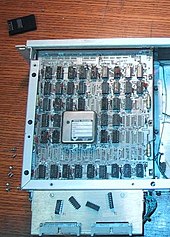
A real-time clock built of TTL chips around 1979
TTL was invented in 1961 by James L. Buie of TRW, which declared it, "particularly suited to the newly developing integrated circuit pattern applied science." The original proper name for TTL was transistor-coupled transistor logic (TCTL).[2] The first commercial integrated-excursion TTL devices were manufactured by Sylvania in 1963, called the Sylvania Universal Loftier-Level Logic family (SUHL).[3] The Sylvania parts were used in the controls of the Phoenix missile.[3] TTL became pop with electronic systems designers afterwards Texas Instruments introduced the 5400 series of ICs, with military temperature range, in 1964 and the later 7400 serial, specified over a narrower range and with inexpensive plastic packages, in 1966.[4]
The Texas Instruments 7400 family became an industry standard. Uniform parts were fabricated by Motorola, AMD, Fairchild, Intel, Intersil, Signetics, Mullard, Siemens, SGS-Thomson, Rifa, National Semiconductor,[five] [6] and many other companies, even in the Eastern Bloc (Soviet Union, GDR, Poland, Czechoslovakia, Hungary, Romania - for details come across 7400 series). Not only did others make compatible TTL parts, but compatible parts were fabricated using many other excursion technologies as well. At least one manufacturer, IBM, produced non-compatible TTL circuits for its own use; IBM used the technology in the IBM System/38, IBM 4300, and IBM 3081.[7]
The term "TTL" is applied to many successive generations of bipolar logic, with gradual improvements in speed and ability consumption over about ii decades. The nearly recently introduced family 74Fxx is withal sold today (equally of 2019), and was widely used into the late 90s. 74AS/ALS Advanced Schottky was introduced in 1985.[viii] As of 2008, Texas Instruments continues to supply the more than general-purpose chips in numerous obsolete technology families, albeit at increased prices. Typically, TTL chips integrate no more than a few hundred transistors each. Functions within a single package generally range from a few logic gates to a microprocessor bit-piece. TTL also became important because its low cost made digital techniques economically applied for tasks previously done by analog methods.[9]
The Kenbak-ane, ancestor of the first personal computers, used TTL for its CPU instead of a microprocessor chip, which was non available in 1971.[x] The Datapoint 2200 from 1970 used TTL components for its CPU and was the basis for the 8008 and later the x86 instruction set.[11] The 1973 Xerox Alto and 1981 Star workstations, which introduced the graphical user interface, used TTL circuits integrated at the level of arithmetic logic units (ALUs) and bitslices, respectively. Near computers used TTL-compatible "glue logic" betwixt larger chips well into the 1990s. Until the advent of programmable logic, detached bipolar logic was used to paradigm and emulate microarchitectures under development.
Implementation [edit]
Primal TTL gate [edit]

2-input TTL NAND gate with a unproblematic output stage (simplified)
TTL inputs are the emitters of bipolar transistors. In the case of NAND inputs, the inputs are the emitters of multiple-emitter transistors, functionally equivalent to multiple transistors where the bases and collectors are tied together.[12] The output is buffered by a common emitter amplifier.
Inputs both logical ones. When all the inputs are held at high voltage, the base–emitter junctions of the multiple-emitter transistor are reverse-biased. Unlike DTL, a pocket-sized "collector" current (approximately 10µA) is drawn by each of the inputs. This is because the transistor is in reverse-active mode. An approximately constant electric current flows from the positive runway, through the resistor and into the base of the multiple emitter transistor.[13] This electric current passes through the base–emitter junction of the output transistor, allowing it to conduct and pulling the output voltage low (logical nada).
An input logical zero. Notation that the base–collector junction of the multiple-emitter transistor and the base of operations–emitter junction of the output transistor are in series betwixt the bottom of the resistor and ground. If i input voltage becomes aught, the corresponding base–emitter junction of the multiple-emitter transistor is in parallel with these two junctions. A miracle called electric current steering means that when two voltage-stable elements with different threshold voltages are continued in parallel, the current flows through the path with the smaller threshold voltage. That is, electric current flows out of this input and into the null (depression) voltage source. As a result, no electric current flows through the base of the output transistor, causing it to stop conducting and the output voltage becomes high (logical one). During the transition the input transistor is briefly in its active region; so it draws a large current abroad from the base of operations of the output transistor and thus quickly discharges its base. This is a critical advantage of TTL over DTL that speeds up the transition over a diode input construction.[xiv]
The master disadvantage of TTL with a simple output stage is the relatively high output resistance at output logical "ane" that is completely adamant by the output collector resistor. Information technology limits the number of inputs that can be continued (the fanout). Some advantage of the elementary output stage is the loftier voltage level (up to VCC) of the output logical "i" when the output is not loaded.
A common variation omits the collector resistor of the output transistor, making an open-collector output. This allows the designer to fabricate logic by connecting the open-collector outputs of several logic gates together and providing a unmarried external pull-up resistor. If any of the logic gates becomes logic low (transistor conducting), the combined output will be low. Examples of this type of gate are the 7401[xv] and 7403 series. Open up-collector outputs of some gates take a higher maximum voltage, such as 15 V for the 7426,[xvi] useful when driving other than TTL loads.
TTL with a "totem-pole" output stage [edit]

Standard TTL NAND with a "totem-pole" output stage, one of four in 7400
To solve the problem with the high output resistance of the elementary output phase the second schematic adds to this a "totem-pole" ("push–pull") output. It consists of the two north-p-due north transistors V3 and 5iv, the "lifting" diode Vfive and the current-limiting resistor Rthree (see the effigy on the right). It is driven by applying the aforementioned electric current steering idea equally to a higher place.
When 5two is "off", Vfour is "off" every bit well and Five3 operates in active region as a voltage follower producing high output voltage (logical "1").
When Vii is "on", it activates Five4, driving low voltage (logical "0") to the output. Once again there is a current-steering effect: the series combination of Fivetwo'southward C-E junction and Viv's B-E junction is in parallel with the series of V3 B-Eastward, V5'south anode-cathode junction, and V4 C-E. The 2nd series combination has the college threshold voltage, so no current flows through it, i.eastward. Viii base current is deprived. Transistor V3 turns "off" and it does not impact on the output.
In the heart of the transition, the resistor Rthree limits the current flowing directly through the series connected transistor Vthree, diode V5 and transistor V4 that are all conducting. It also limits the output electric current in the instance of output logical "i" and brusque connectedness to the ground. The force of the gate may be increased without proportionally affecting the power consumption by removing the pull-up and pull-down resistors from the output stage.[17] [18]
The chief advantage of TTL with a "totem-pole" output phase is the depression output resistance at output logical "1". Information technology is determined by the upper output transistor V3 operating in active region as an emitter follower. The resistor R3 does not increase the output resistance since it is connected in the Vthree collector and its influence is compensated by the negative feedback. A disadvantage of the "totem-pole" output stage is the decreased voltage level (no more than iii.5 V) of the output logical "1" (even if the output is unloaded). The reason of this reduction are the voltage drops across the V3 base–emitter and V5 anode–cathode junctions.
Interfacing considerations [edit]
Like DTL, TTL is a current-sinking logic since a current must exist fatigued from inputs to bring them to a logic 0 voltage level. The driving stage must absorb up to one.6 mA from a standard TTL input while not allowing the voltage to ascension to more than 0.4 volts.[nineteen] The output stage of the most common TTL gates is specified to role correctly when driving upward to 10 standard input stages (a fanout of 10). TTL inputs are sometimes simply left floating to provide a logical "1", though this usage is not recommended.[20]
Standard TTL circuits operate with a 5-volt power supply. A TTL input indicate is defined as "low" when betwixt 0 5 and 0.8 V with respect to the ground terminal, and "high" when between 2 V and 5CC (5 5),[21] [22] and if a voltage indicate ranging between 0.eight Five and two.0 V is sent into the input of a TTL gate, in that location is no certain response from the gate and therefore information technology is considered "uncertain" (precise logic levels vary slightly between sub-types and by temperature). TTL outputs are typically restricted to narrower limits of between 0.0 V and 0.4 V for a "depression" and betwixt ii.4 V and VCC for a "high", providing at to the lowest degree 0.4 V of racket immunity. Standardization of the TTL levels is and so ubiquitous that circuitous circuit boards ofttimes incorporate TTL chips fabricated by many different manufacturers selected for availability and price, compatibility being assured. Two circuit board units off the same assembly line on different successive days or weeks might have a different mix of brands of fries in the same positions on the board; repair is possible with chips manufactured years later than original components. Inside usefully broad limits, logic gates can exist treated as ideal Boolean devices without business organization for electrical limitations. The 0.4V noise margins are acceptable because of the low output impedance of the driver phase, that is, a large amount of noise power superimposed on the output is needed to bulldoze an input into an undefined region.
In some cases (due east.g., when the output of a TTL logic gate needs to be used for driving the input of a CMOS gate), the voltage level of the "totem-pole" output stage at output logical "1" tin exist increased closer to FiveCC past connecting an external resistor between the V4 collector and the positive runway. It pulls up the 55 cathode and cuts-off the diode.[23] However, this technique actually converts the sophisticated "totem-pole" output into a unproblematic output stage having significant output resistance when driving a high level (determined past the external resistor).
Packaging [edit]
Like nigh integrated circuits of the menstruation 1963–1990, commercial TTL devices are usually packaged in dual in-line packages (DIPs), usually with xiv to 24 pins,[24] for through-hole or socket mounting. Epoxy plastic (PDIP) packages were often used for commercial temperature range components, while ceramic packages (CDIP) were used for war machine temperature range parts.
Beam-lead chip dies without packages were made for assembly into larger arrays equally hybrid integrated circuits. Parts for military and aerospace applications were packaged in flatpacks, a form of surface-mountain package, with leads suitable for welding or soldering to printed circuit boards. Today[ when? ], many TTL-compatible devices are available in surface-mount packages, which are available in a wider array of types than through-hole packages.
TTL is peculiarly well suited to bipolar integrated circuits because additional inputs to a gate merely required additional emitters on a shared base region of the input transistor. If individually packaged transistors were used, the toll of all the transistors would discourage ane from using such an input structure. Simply in an integrated circuit, the additional emitters for extra gate inputs add merely a small area.
At to the lowest degree one computer manufacturer, IBM, built its ain flip chip integrated circuits with TTL; these chips were mounted on ceramic multi-bit modules.[25] [26]
Comparison with other logic families [edit]
TTL devices consume substantially more power than equivalent CMOS devices at residual, but power consumption does not increase with clock speed equally rapidly as for CMOS devices.[27] Compared to contemporary ECL circuits, TTL uses less power and has easier pattern rules but is substantially slower. Designers can combine ECL and TTL devices in the aforementioned system to accomplish best overall performance and economy, but level-shifting devices are required between the 2 logic families. TTL is less sensitive to damage from electrostatic discharge than early CMOS devices.
Due to the output structure of TTL devices, the output impedance is asymmetrical between the high and low state, making them unsuitable for driving transmission lines. This drawback is usually overcome by buffering the outputs with special line-driver devices where signals need to be sent through cables. ECL, past virtue of its symmetric low-impedance output structure, does non have this drawback.
The TTL "totem-pole" output structure often has a momentary overlap when both the upper and lower transistors are conducting, resulting in a substantial pulse of electric current drawn from the power supply. These pulses can couple in unexpected ways between multiple integrated circuit packages, resulting in reduced dissonance margin and lower performance. TTL systems normally have a decoupling capacitor for every one or two IC packages, and then that a current pulse from one TTL fleck does not momentarily reduce the supply voltage to some other.
Since the mid 1980s, several manufacturers supply CMOS logic equivalents with TTL-compatible input and output levels, usually bearing part numbers similar to the equivalent TTL component and with the aforementioned pinouts. For instance, the 74HCT00 series provides many drib-in replacements for bipolar 7400 series parts, but uses CMOS applied science.
Sub-types [edit]
Successive generations of technology produced compatible parts with improved ability consumption or switching speed, or both. Although vendors uniformly marketed these various product lines every bit TTL with Schottky diodes, some of the underlying circuits, such as used in the LS family, could rather exist considered DTL.[28]
Variations of and successors to the basic TTL family, which has a typical gate propagation filibuster of 10ns and a power dissipation of 10 mW per gate, for a power–filibuster product (PDP) or switching free energy of about 100 pJ, include:
- Depression-power TTL (L), which traded switching speed (33ns) for a reduction in power consumption (1 mW) (now essentially replaced by CMOS logic)
- High-speed TTL (H), with faster switching than standard TTL (6ns) but significantly higher ability dissipation (22 mW)
- Schottky TTL (S), introduced in 1969, which used Schottky diode clamps at gate inputs to prevent charge storage and amend switching fourth dimension. These gates operated more than chop-chop (3ns) but had higher power dissipation (19 mW)
- Low-power Schottky TTL (LS) – used the higher resistance values of low-power TTL and the Schottky diodes to provide a good combination of speed (ix.5ns) and reduced power consumption (2 mW), and PDP of nigh 20 pJ. Probably the most common type of TTL, these were used equally glue logic in microcomputers, essentially replacing the former H, L, and S sub-families.
- Fast (F) and Avant-garde-Schottky (As) variants of LS from Fairchild and TI, respectively, circa 1985, with "Miller-killer" circuits to speed up the depression-to-high transition. These families achieved PDPs of ten pJ and 4 pJ, respectively, the lowest of all the TTL families.
- Depression-voltage TTL (LVTTL) for 3.3-volt power supplies and memory interfacing.
About manufacturers offer commercial and extended temperature ranges: for example Texas Instruments 7400 series parts are rated from 0 to 70 °C, and 5400 series devices over the military-specification temperature range of −55 to +125 °C.
Special quality levels and high-reliability parts are available for military and aerospace applications.
Radiations-hardened devices (for example from the SNJ54 serial) are offered for space applications.
Applications [edit]
Earlier the appearance of VLSI devices, TTL integrated circuits were a standard method of construction for the processors of minicomputer and mainframe computers; such as the December VAX and Information General Eclipse, and for equipment such as machine tool numerical controls, printers and video display terminals. As microprocessors became more functional, TTL devices became important for "glue logic" applications, such as fast bus drivers on a motherboard, which tie together the function blocks realized in VLSI elements.
Analog applications [edit]
While originally designed to handle logic-level digital signals, a TTL inverter can be biased as an analog amplifier. Connecting a resistor betwixt the output and the input biases the TTL element equally a negative feedback amplifier. Such amplifiers may exist useful to catechumen analog signals to the digital domain but would not usually be used where analog distension is the primary purpose.[29] TTL inverters tin can also be used in crystal oscillators where their analog distension ability is significant.
A TTL gate may operate inadvertently equally an analog amplifier if the input is connected to a slowly changing input signal that traverses the unspecified region from 0.8 V to 2 V. The output can be erratic when the input is in this range. A slowly changing input like this can also cause excess power dissipation in the output circuit. If such an analog input must be used, there are specialized TTL parts with Schmitt trigger inputs available that will reliably convert the analog input to a digital value, effectively operating equally a one fleck A to D converter.
Run into as well [edit]
- List of 7400 serial integrated circuits
References [edit]
- ^ Eren, H. (2003), Electronic Portable Instruments: Pattern and Applications, CRC Press, ISBN0-8493-1998-half dozen
- ^ US 3283170, Buie, James L., "Coupling transistor logic and other circuits", issued 1966-11-01, assigned to TRW Semiconductors, Inc.
- ^ a b The Figurer History Museum. 1963 - Standard Logic Families Introduced. 2007. Retrieved 16 April 2008.
- ^ Lojek, Bo (2006), History of semiconductor technology, Springer, pp. 212–215, ISBN3-540-34257-5
- ^ Engineering Staff. The TTL Data Book for Blueprint Engineers. 1st Ed. Dallas: Texas Instruments. 1973.
- ^ Turner, L. Due west., ed. (1976), Electronics Engineer's Reference Book (4th ed.), London: Newnes-Butterworth, ISBN0408001682
- ^ , p. v.
- ^ Texas Instruments. Advanced Schottky Family. 1985. Retrieved 17 September 2008.
- ^ Lancaster, D (1975), TTL Cookbook, Indianapolis: Howard W. Sams and Co., p. preface, ISBN0-672-21035-5
- ^ Klein, E. Kenbak-1. Vintage-Estimator.com. 2008.
- ^ Lamont Woods, "Forgotten PC history: The truthful origins of the personal computer" Archived 2008-08-14 at the Wayback Machine, Computerworld, viii August 2008
- ^ Gray, Paul E.; Searle, Campbell Fifty. (1969), Electronic Principles Physics, Models, and Circuits (1st ed.), Wiley, p. 870, ISBN978-0471323983
- ^ Buie 1966, column 4
- ^ Millman, J. (1979), Microsystem electronics Digital and Analog Circuits and Systems, New York: McGraw-Hill Book Visitor, p. 147, ISBN0-07-042327-X
- ^ SN7401 datasheet – Texas Instruments
- ^ SN7426 datasheet – Texas Instruments
- ^ Transistor–Transistor Logic (TTL). siliconfareast.com. 2005. Retrieved 17 September 2008. p. 1.
- ^ Tala, D. Chiliad. Digital Logic Gates Part-Five. asic-world.com. 2006.
- ^ SN7400 datasheet - Texas Instruments
- ^ Haseloff, Eilhard. "Designing With Logic" (PDF). TI.com. Texas Instruments Incorporated. pp. half-dozen–7. Retrieved 27 October 2018.
- ^ TTL logic levels
- ^ "DM7490A Decade and Binary Counter" (PDF). Fairchild. Retrieved 14 October 2016.
- ^ TTL-to-CMOS Interfacing Techniques Archived 2010-09-19 at the Wayback Machine
- ^ Marston, R. M. (2013). Modern TTL Circuits Transmission. Elsevier. p. sixteen. ISBN9781483105185.
[74-series] devices are usually encapsulated in a plastic xiv-pin, sixteen-pin, or 24-pin dual-in-line package (DIP)
- ^ Rymaszewski, E. J.; Walsh, J. L.; Leehan, Thou. W. (1981), "Semiconductor Logic Technology in IBM", IBM Journal of Research and Development, 25 (five): 603–616, doi:10.1147/rd.255.0603
- ^ Seraphim, D. P.; Feinberg, I. (1981), "Electronic Packaging Development in IBM", IBM Periodical of Research and Development, 25 (v): 617–630, doi:ten.1147/rd.255.0617
- ^ Horowitz, Paul; Hill, Winfield (1989), The Art of Electronics (second ed.), Cambridge University Printing, p. 970, ISBN0-521-37095-7 states, "...CMOS devices eat ability proportional to their switching frequency...At their maximum operating frequency they may utilize more ability than equivalent bipolar TTL devices."
- ^ Ayers, J. UConn EE 215 notes for lecture 4. Harvard University faculty web page. Archive of spider web page from University of Connecticut. due north.d. Retrieved 17 September 2008.
- ^ Wobschall, D. (1987), Circuit Blueprint for Electronic Instrumentation: Analog and Digital Devices from Sensor to Display (2d ed.), New York: McGraw Hill, pp. 209–211, ISBN0-07-071232-8
Farther reading [edit]
- Lessons in Electrical Circuits - Volume IV - Digital; Tony Kuphaldt; Open up Book Project; 508 pages; 2007. (Chapter 3 Logic Gates)
External links [edit]
 | Wikimedia Eatables has media related to TTL. |
- Fairchild Semiconductor. An Introduction to and Comparison of 74HCT TTL Compatible CMOS Logic (Application Notation 368). 1984. (for relative ESD sensitivity of TTL and CMOS.)
- Texas Instruments logic family application notes
bissonnetteliecomand.blogspot.com
Source: https://en.wikipedia.org/wiki/Transistor%E2%80%93transistor_logic
0 Response to "A Momentary Variation of Voltage From One Logic Level to the Opposite Level and Back Again"
Post a Comment